
Case Studies
Our Impact Through Data
Explore how GeoDecision Analytics specialists apply spatial intelligence to address complex environmental, infrastructure, and data-driven decision challenges.
“Case studies are presented in a generalised form to illustrate analytical approaches while respecting organisational and research confidentiality requirements”
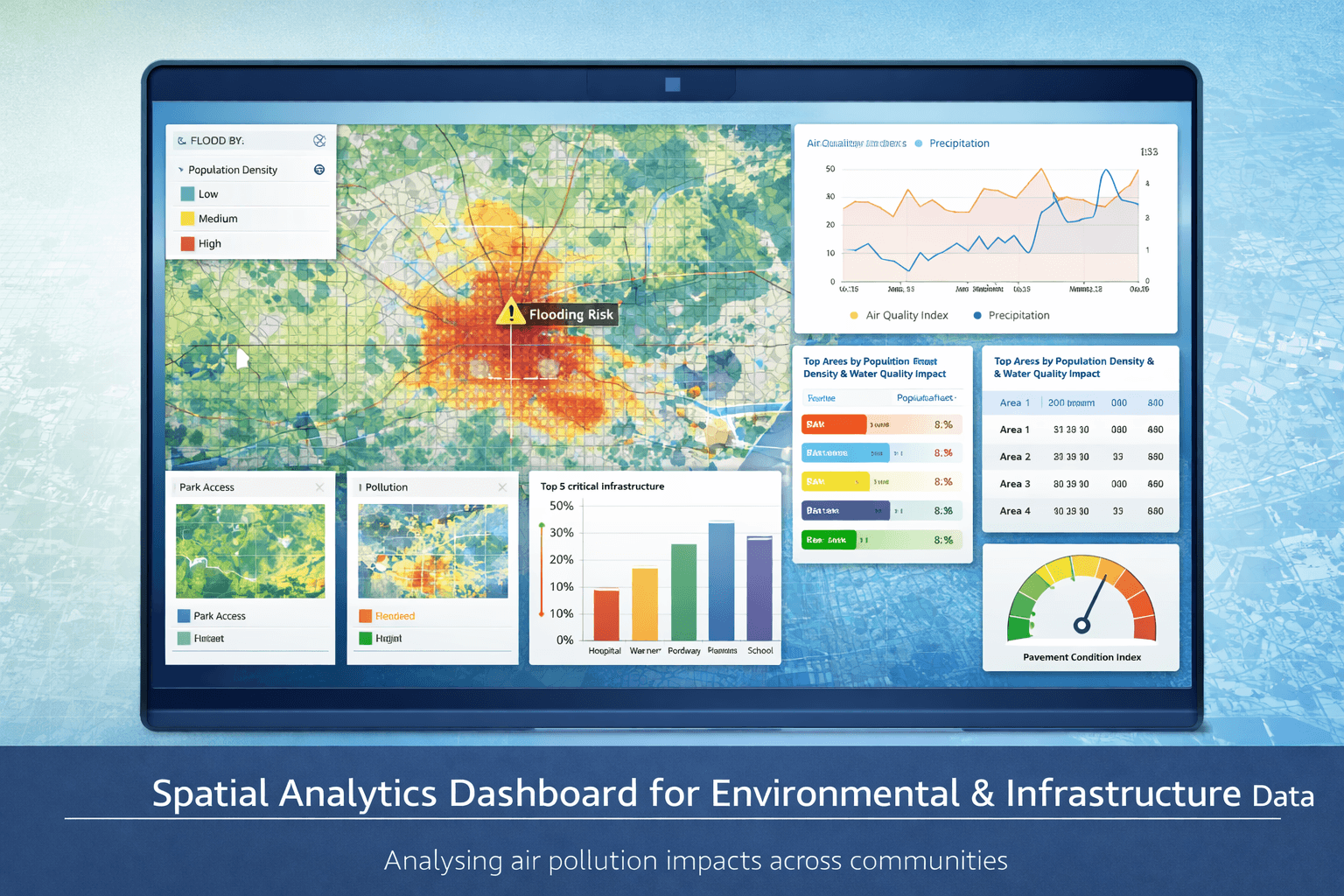
Spatial Analytics Dashboard for Environmental & Infrastructure Data
Interactive Spatial Analytics and Decision-Support Dashboard
This case study demonstrates the development of a spatial analytics dashboard designed to support data exploration and decision-making through interactive geospatial visualisation.
Project Overview
This case study demonstrates the development of a spatial analytics dashboard designed to support data exploration and decision-making through interactive geospatial visualisation. By integrating multiple datasets into a unified dashboard interface, spatial information can be explored dynamically, enabling stakeholders to quickly understand spatial patterns, trends, and relationships across regions.
Project Context
Organisations working with environmental, infrastructure, or socio-economic datasets often need tools that allow them to explore complex spatial information efficiently. Static maps and reports can limit the ability to interact with data and identify patterns. To address this challenge, a spatial dashboard was designed to integrate geospatial datasets, environmental indicators, and spatial metrics into an interactive visual interface that allows users to filter, visualise, and interpret spatial data in real time.
Analytical Approach
The dashboard integrates spatial datasets within a GIS-enabled analytical environment and provides interactive visualisation tools for exploring spatial patterns. Key components of the dashboard include map-based visualisation, statistical charts, and dynamic filtering tools that allow users to examine geographic patterns across different variables. The workflow involved preparing spatial datasets, standardising geographic layers, linking spatial attributes to analytical indicators, and designing visual outputs that support intuitive exploration of spatial information.
Key Insights
“The spatial dashboard demonstrates how interactive geospatial visualisation can transform complex datasets into accessible decision-support tools. By enabling users to explore spatial relationships dynamically, dashboards can support data-driven planning, monitoring, and strategic decision-making across environmental management, infrastructure planning, and policy analysis contexts.”
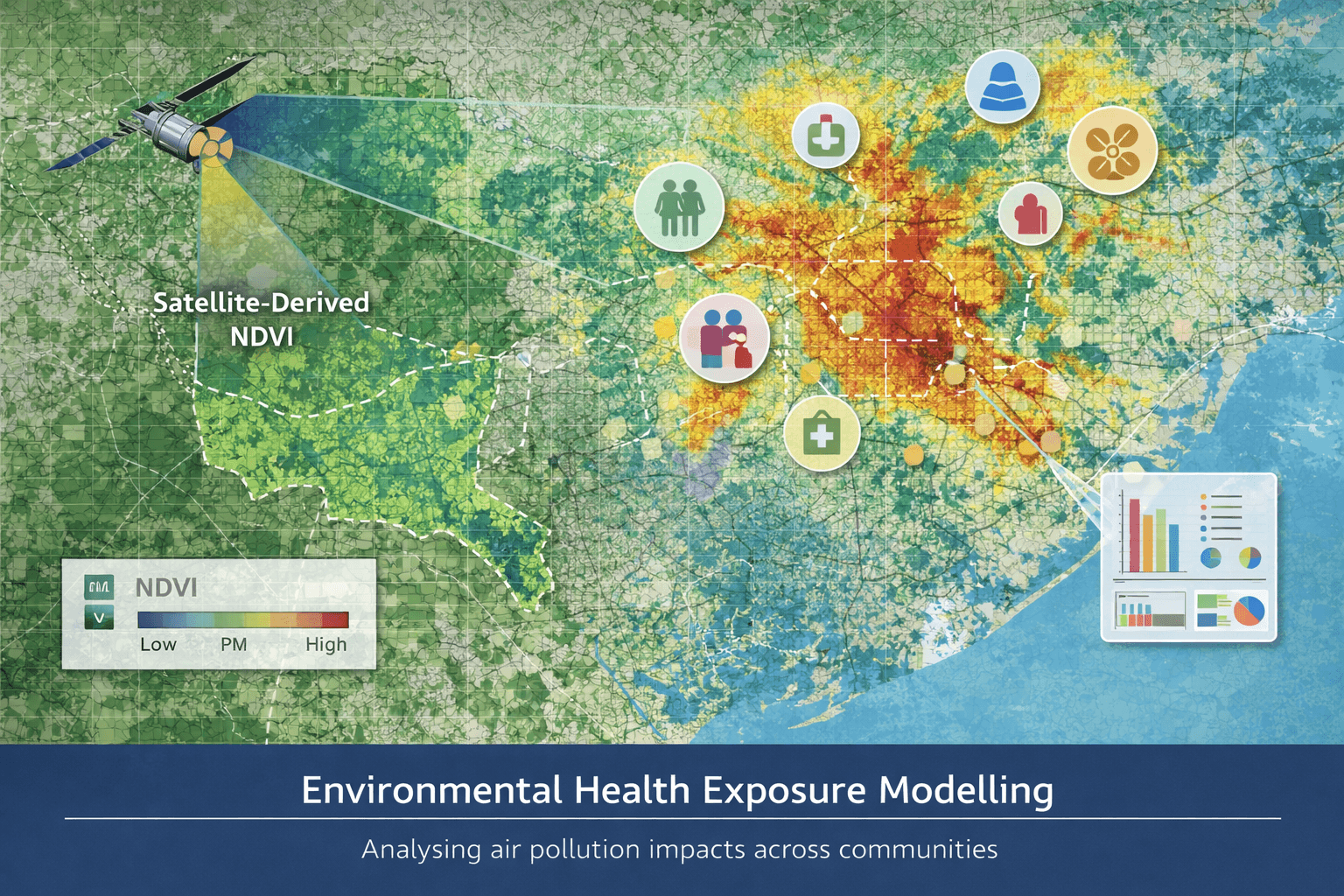
Environmental Health Exposure Modelling
Environmental Exposure Modelling and Public Health Analytics
Investigating the relationship between environmental conditions and population health through spatial data integration. Developed through multidisciplinary collaboration, this research-driven study supports evidence-based environmental epidemiology.
Project Overview
This case study reflects spatial analysis and environmental exposure modelling experience developed through academic research and collaboration with multidisciplinary public health and environmental science teams. The work demonstrates how geospatial methods can be used to investigate the relationship between environmental conditions and population health outcomes by integrating environmental datasets with demographic and health information.
Project Context
Understanding how environmental factors influence human health requires the integration of large-scale spatial datasets from multiple sources. In this analysis, environmental exposure modelling was conducted to examine the relationships between greenspace, air pollution, and health outcomes across large population datasets. The study combined satellite-derived environmental indicators, air pollution datasets, and demographic health survey data to generate spatial exposure metrics suitable for epidemiological analysis.
Analytical Approach
The spatial analysis involved integrating satellite-derived vegetation indices such as EVI and NDVI with population health datasets and processing air pollution exposure surfaces (e.g., PM₂.₅) to quantify environmental exposure patterns. Geospatial statistical modelling techniques were applied to investigate potential associations between environmental factors and health outcomes. The analysis also included the generation of spatial visualisations and analytical outputs to support scientific interpretation and research communication.
Key Insights
“The environmental exposure modelling provided valuable insights into spatial patterns of environmental risk and their potential influence on population health. By integrating environmental datasets with demographic health information, the analysis contributed to a deeper understanding of environmental determinants of health and supported evidence-based research in environmental epidemiology. The results also demonstrated how spatial analysis can inform public health research, policy discussions, and environmental health planning.”
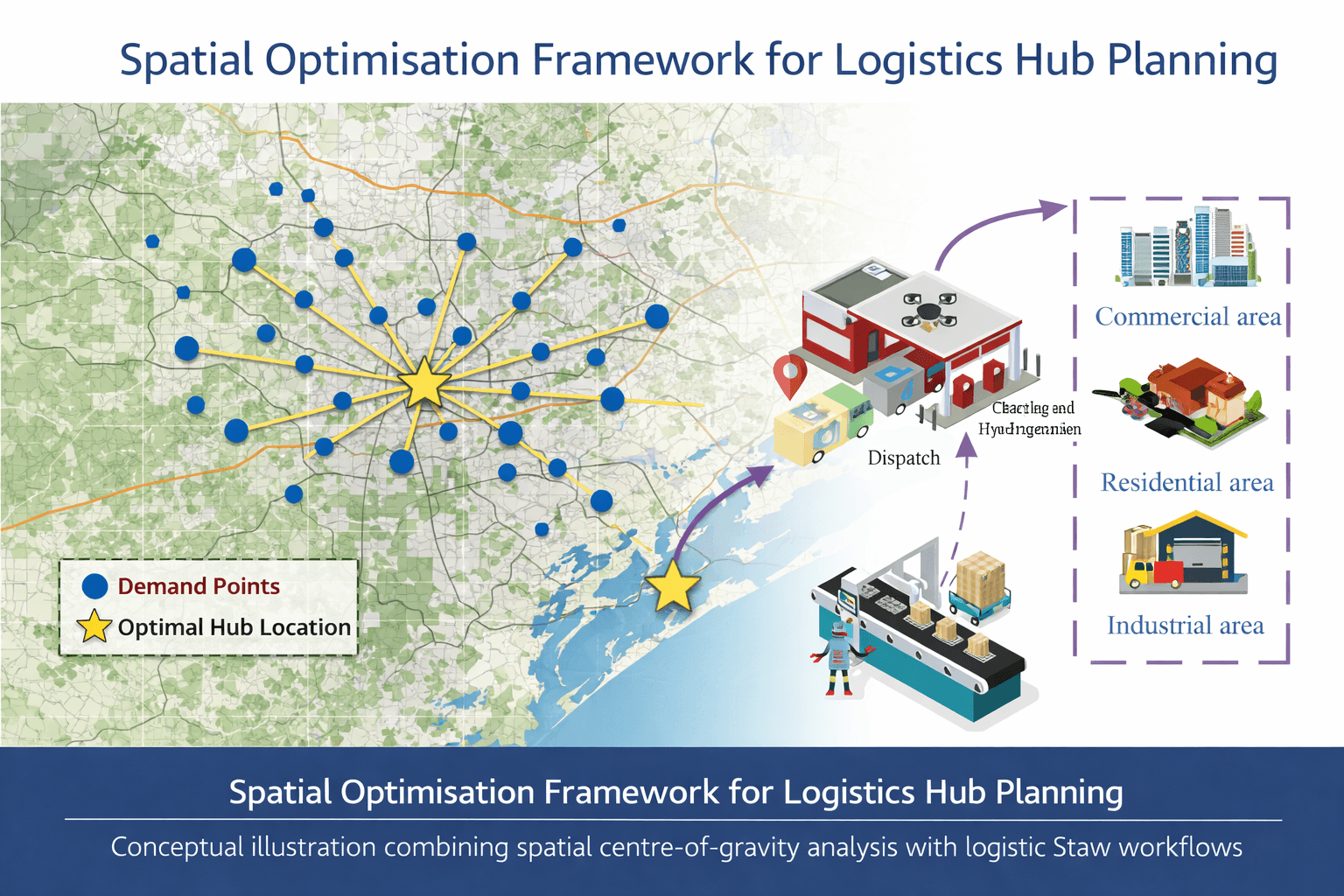
Logistics Hub Location Optimisation
Strategic Logistics Hub Selection through Spatial Optimisation
Demonstrating the application of Centre-of-Gravity (CoG) modelling and geospatial analysis for strategic supply chain planning. This study illustrates how spatial intelligence identifies optimal distribution hub locations.
Project Overview
This case study demonstrates the application of spatial optimisation techniques for business location planning. Using geospatial analysis, the study illustrates how spatial data can support strategic decision-making in logistics, distribution planning, and infrastructure location selection. By analysing the geographic distribution of demand, spatial modelling can help identify locations that improve operational efficiency and reduce transportation costs.
Project Context
Businesses with widely distributed customer demand often face challenges in determining the most efficient location for distribution centres or logistics hubs. Poorly positioned facilities can lead to higher transportation costs, longer delivery times, and inefficient supply chain operations. To address this challenge, spatial data representing customer or demand locations, shipment volume or demand intensity, and regional geographic coordinates were integrated within a GIS environment. These datasets provided the spatial foundation for analysing demand distribution and identifying an optimal hub location.
Analytical Approach
A Centre-of-Gravity (CoG) spatial optimisation model was applied to determine the weighted mean location that minimises overall transportation distance across the demand network. The analysis involved preparing demand location datasets, assigning weights based on shipment volumes, and calculating weighted spatial coordinates. The resulting model was visualised within QGIS, enabling spatial representation of demand distribution and the identification of a strategically positioned logistics hub.
Key Insights
“The spatial optimisation analysis demonstrated how geospatial modelling can support datadriven logistics and infrastructure planning. By identifying a location closer to the weighted demand centre, the analysis highlighted opportunities to reduce transportation distances and improve distribution efficiency. This approach provides organisations with a structured framework for site selection, supply chain optimisation, and strategic logistics planning using spatial intelligence.”
Have a Complex Spatial Challenge?
Our team of specialists can help you translate raw spatial data into defensible insights and strategic decisions.